Freight Rate Management Engine: How to Build Dynamic Pricing and Rate Comparison Modules
| What This Guide Covers 1. The Problem: Why Spreadsheet Rate Management Breaks 2. How Freight Rates Are Actually Calculated 3. What a Freight Rate Management Engine Does 4. Architecture: The Five Building Blocks 5. Carrier Rate API Integration and Normalization 6. Dynamic Pricing: How the Engine Adjusts in Real Time 7. Multi-Carrier Rate Comparison and Selection 8. Cost and Timeline to Build (US, UK, and EU) 9. Case Study: A Custom Platform Built to Fit 10. Frequently Asked Questions |
The Problem: Why Spreadsheet Rate Management Breaks
Most freight businesses start with a spreadsheet of carrier rates, and for a while it works. Then volume grows, carriers send dozens of rate updates a week, surcharges multiply, and the spreadsheet quietly turns into a liability. A quote goes out on last month’s rate, and the margin vanishes. A faster, cheaper carrier is missed because nobody had time to check all of them. This is the moment freight rate management software stops being a nice-to-have, and it is usually when our custom software product development team gets the call.
The cost of staying on spreadsheets is real, even if it never shows up as a line item. It shows up as lost bookings when a quote is slow, as eroded margins when a rate is wrong, and as hours of manual data entry that a team will never get back. Ocean freight surcharges alone can run into the dozens per carrier, each with its own effective date and rule. Keeping that straight by hand is not a discipline problem; it is a tooling problem. A rate engine fixes it by making the rates, the rules, and the comparison automatic.
The pressure behind this is not imaginary, and it is worth grounding in official data before we design anything. According to the U.S. Department of Transportation, the Bureau of Transportation Statistics Producer Price Index shows freight transportation and equipment prices rose 2.3 percent year on year into 2026, and its Freight Transportation Services Index moves every month. When the cost of moving freight shifts that often, a fixed rate table is out of date almost as soon as it is saved.
Before we design an engine, it helps to be clear about what we are pricing and how the numbers come together. That is where I always start a client conversation, because the calculation logic shapes the whole build. For the wider system this engine plugs into, and where rating sits within it, our guide on logistics and supply chain software development sets the full picture.
How Freight Rates Are Actually Calculated
Freight rates are calculated from a base rate set by weight, distance, and mode, then adjusted by a stack of surcharges and market factors. The base differs by mode: trucking often prices on weight, density, and a freight class, where denser goods can qualify for a lower class and a lower per-mile cost. Air freight prices on chargeable weight, the greater of actual and volumetric weight.
Ocean freight prices per container or per cubic meter, which is why the same shipment can cost wildly different amounts depending on how it moves. Modeling that base logic cleanly is detailed data work, and it is the part of the build our Python developers own end-to-end.
On top of the base sits the part that trips up every spreadsheet: the adjustments. Fuel surcharges, capacity availability, transit urgency, and seasonal demand all move the final number, sometimes daily. A rate that was right on Monday can be wrong by Friday. This is exactly why a rate engine has to separate the stable base from the volatile adjustments, so each can be updated on its own schedule without breaking the other. Getting that separation right in the data model is the single most important design decision in the whole build.
For complex rule sets across many lanes and modes, we often pair that data work with a dedicated software development team so the same engineers hold the domain knowledge over time, rather than relearning it on every change.
Where this calculation sits alongside routing, tracking, and the rest of the transport stack is covered in our guide on how transportation management systems work.
What a Freight Rate Management Engine Does
A freight rate management engine does four jobs that a spreadsheet cannot. It maintains a single, current database of carrier rates instead of scattered files. It calculates a live price for any shipment by applying the right base and surcharges automatically. It compares carriers on cost and transit time so the best option is picked without manual checking. And it manages validity, flagging and removing rates that have expired so a stale number never reaches a customer. Our developers build this calculation and comparison core because Python suits the data and rules work especially well.
The shift this creates is from reactive to instant. Instead of a salesperson digging through files to build a quote over hours, the engine returns an accurate, ranked answer in seconds. That speed is not a vanity metric; in freight, the first accurate quote often wins the booking. The same engine also becomes the source of truth that feeds your booking and invoicing, so the rate that was quoted is the rate that gets billed. When the engine evolves into a full product with dashboards, user roles, and reporting, businesses often choose to hire MERN stack developers to accelerate development and scaling.
Architecture: The Five Building Blocks
Every freight rate engine we build comes down to five building blocks, and keeping them cleanly separated is what makes the system maintainable as carriers and rules change. The first is the rate ingestion layer, which pulls rates in from carrier APIs and rate sheets. The second is the normalization layer, which turns every carrier’s different format into one consistent structure.
The third is the pricing engine, which applies the base rate and surcharges to produce a number. The fourth is the comparison and selection layer, which ranks carriers, and the fifth is the integration layer, which feeds the result into your TMS, booking, and accounting systems. Designing these layers so they stay clean as the system grows is exactly the kind of work our product development team plans up front.
The reason this separation matters is change. Carriers change formats, surcharges change rules, and your business changes how it wants to rank options. When each concern lives in its own layer, a change in one place does not ripple through the rest.
This is the difference between a system that ages well and one that becomes its own spreadsheet five years later. Teams that already have engineers and just need to add this capability often bring in extra skills through staff augmentation rather than hiring for a single build.
Carrier Rate API Integration and Normalization
Carrier rate API integration is the part clients underestimate, and it is where most of the engineering effort goes. A freight rate API connects your system directly to a carrier’s rate platform, fetches updated rates automatically, applies your business rules, and pushes the result into your quoting and booking modules. Most modern APIs use standard REST or SOAP protocols, so the connection itself is well-trodden.
The hard part is not connecting; it is making dozens of different carrier responses agree. When this layer needs to scale and stay reliable under real volume, our DevOps engineers handle the infrastructure behind it. That agreement is the job of normalization. One carrier sends clean JSON, another sends a PDF rate sheet by email, a third sends an Excel file with its own column names. AI-assisted ingestion can now read those unstructured sheets, extract the pricing, and load it into the database, which removes hours of manual entry every week.
Once everything is normalized into one structure, the rest of the engine can treat every carrier the same way, and I tell clients this is the unglamorous core that decides whether the whole engine is trustworthy. That AI-assisted reading of messy rate sheets is built by our AI and ML engineers, who turn unstructured PDFs and spreadsheets into clean, structured data. The modeling techniques behind automated extraction are covered in our guide on AI and machine learning in logistics.
Dynamic Pricing: How the Engine Adjusts in Real Time
Dynamic freight pricing is the engine that adjusts quotes automatically based on live signals such as carrier capacity, fuel costs, lane demand, and market indices. As market conditions change, prices update in real time, ensuring accurate quotes. Building such data-driven logistics platforms often requires scalable web applications, which is why many businesses choose to hire MEAN stack developers from Acquaint Softtech for custom development.
The predictive models behind these live signals are built by our AI development services team. Building this well is a balance between automation and control. You want the engine to react to the market, but you also want guardrails so it never quotes below a floor or above a ceiling you set. In my experience, the right design lets the business set the rules and lets the engine apply them at speed, rather than handing pricing entirely to an algorithm.
That combination is what protects margin while staying competitive. For founders who want senior technical direction on how far to push automation, our virtual CTO services provide that without a full-time hire.
Multi-Carrier Rate Comparison and Selection
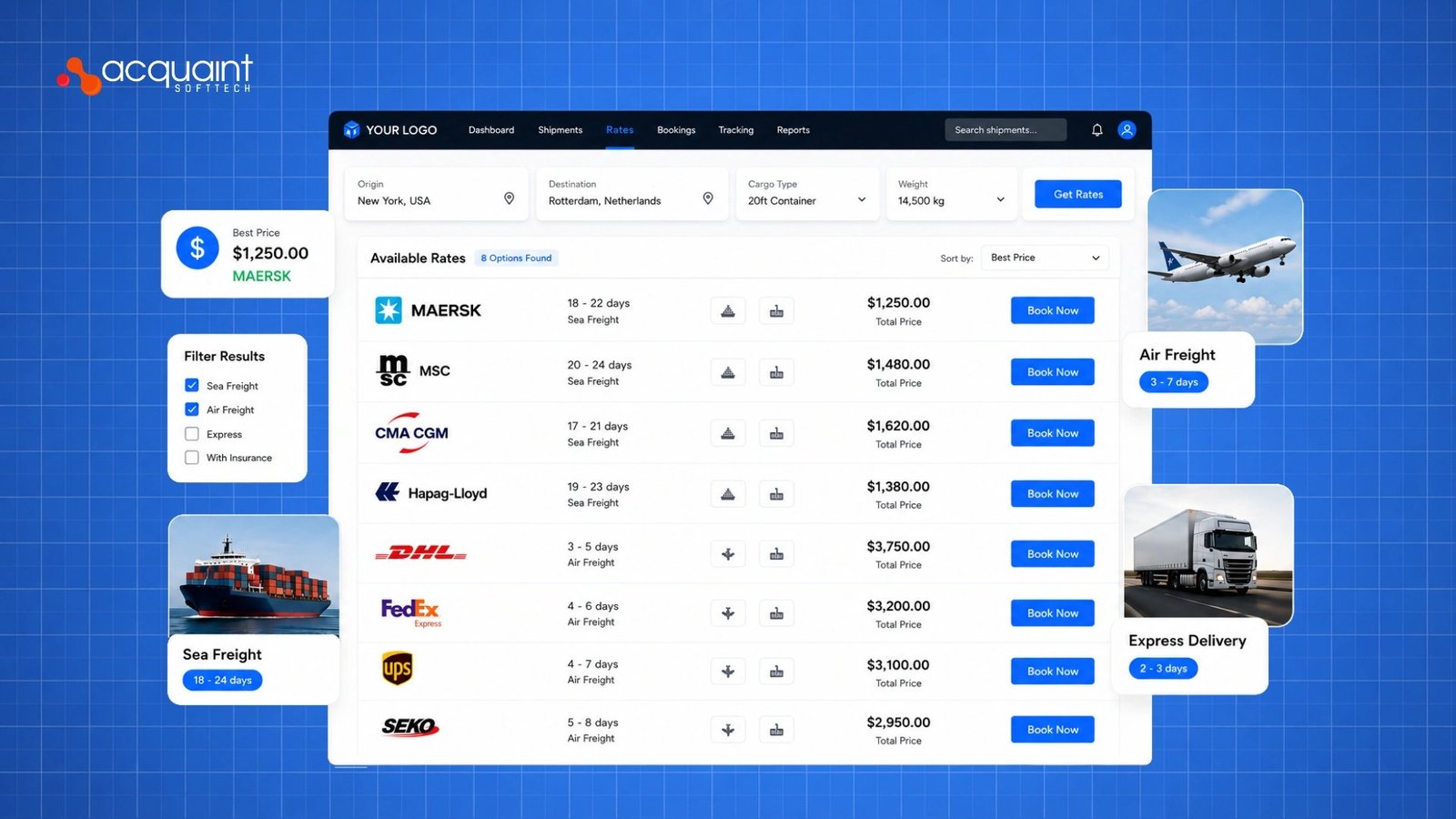
Multi-carrier rate comparison is where the engine earns its keep for the people using it every day. Once rates are normalized and priced, the engine ranks carriers for a given shipment on the factors that matter: total cost, transit time, and reliability. For ocean freight especially, showing vessel schedules and transit times alongside the rate lets a team choose on speed and cost together, not cost alone. The result is a ranked shortlist a salesperson can quote from in seconds. For teams without an in-house engineering function, we run this whole build as a managed engagement through software development outsourcing.
The selection logic should reflect how your business actually decides. Some clients always want the cheapest compliant option; others weigh a reliable carrier higher even at a small premium, because a missed sailing costs more than the saving.
We make those rules configurable rather than hard-coded, so the engine encodes your judgment and applies it consistently, which removes the human guesswork that quietly erodes margin. Companies that want to offer rate comparison under their own brand can do so with our white label development services. How to choose the right engagement model for this is covered in our guide on IT outsourcing vs software outsourcing vs staff augmentation.
Cost and Timeline to Build (US, UK, and EU)
Cost depends on how many carriers you integrate, how complex your pricing rules are, and whether you need dynamic pricing from day one. The honest way to budget is by stage, because a focused first version proves the engine before you commit to the full build. The ranges below are what we quote as a starting point, shown in the currency of each target market so the numbers are easy to read wherever you operate.
| Build stage | Indicative cost (USD / GBP / EUR) | Timeline |
| Core engine MVP (ingestion, pricing, comparison) | $40K-70K / £32K-55K / €37K-65K | 3 to 4 months |
| Multi-carrier API integration and normalization | $60K-110K / £48K-88K / €56K-102K | 4 to 6 months |
| Full engine with dynamic pricing and TMS hooks | $110K-200K+ / £88K-160K+ / €102K-185K+ | 6 to 10 months |
The biggest lever on these figures is where the work is done. Building with an experienced India-based team delivers the same engineering quality at up to 40 percent below typical US, UK, and EU agency rates, which is why most of our freight clients build offshore. The currency you pay in does not change the engineering; it changes the bill. To keep that first version lean and the budget controlled, we scope it in a discovery workshop before any code is written.
One practical note on budgeting: the integration layer is usually the largest single line, not the pricing logic. Teams that plan for that up front avoid the overruns that catch others out. The pricing engine itself is often the quickest part to build, which surprises people. The slow, careful work is always the carrier data.
Once the engine is live, keeping it current as carriers and rules change is handled through our support and maintenance services. Keeping spend efficient across all of it, without cutting quality, is its own discipline, and we wrote about it in our guide on reducing software development costs without reducing quality.
Read Also: Best Home-Based Techniques for Controlling High Blood Pressure
Case Study: A Custom Platform Built to Fit
To ground this in real work, consider the custom B2B and B2C marketplace platform we built for a client, referenced publicly by Darren Fuller of Pinpoint. It is not a freight engine, but it solved the same underlying problem a rate engine solves: turning scattered, manual, supplier-by-supplier data into one automated, reliable system. The parallel is close enough to be instructive, and it shows how we approach exactly this class of build. For businesses looking to accelerate similar custom platform development, working with experienced teams or choosing to hire Laravel developers can help streamline delivery and scalability.
| The problem. The operation could not run on a standard off-the-shelf product. Supplier and product data arrived in different formats and were handled manually, which was slow and error-prone, and the catalog was too large and too multi-vendor for a packaged tool to manage cleanly.The challenge. More than 100 vendors and sub-vendors each needed their own rules and storefront, supplier data had to be imported reliably at scale, and every vendor expected accurate, current information without a team rekeying it by hand. That is the same normalization-and-automation challenge at the heart of a freight rate engine.How we solved it. We built a custom API to import supplier and product data reliably, replacing the manual handling. We modeled multi-level product categories with high capacity so vendors could scale catalogs without hitting limits, and we gave the admin full control over vendors, roles, and per-vendor settings, the kind of control a packaged product rarely allows.The result. The platform went live on time with 57 vendors and counting, running as a working system rather than a stalled customization project, with supplier reporting and analysis a packaged dashboard would not produce. The client noted the team worked even on weekends and provided exceptional support with excellent communication. |
The lesson maps straight onto a freight rate engine. When your data is scattered across formats, and your rules are specific to your business, the path that wins is a custom system that normalizes the data and automates the decisions, exactly as it did here. You can review this and other delivered work in our portfolio of client case studies.
Proof of work matters more than promises, so it is worth verifying independently. Across 1,300+ delivered projects over 13+ years, Acquaint Softtech holds a 4.9/5 rating with Premier Verified status on our Clutch profile, drawn from 50+ client reviews.
“When a freight client asks me where a rate engine succeeds or fails, my answer is always the same: it is the normalization layer, not the pricing. Anyone can multiply weight by a rate. The hard, valuable work is making thirty carriers in thirty formats behave like one clean source of truth. Get that right and dynamic pricing and comparison fall into place on top. Get it wrong, and you have rebuilt your spreadsheet with extra steps.” – Sanjay Prajapati, Head of Business and Engineering, Acquaint Softtech
Frequently Asked Questions
How are freight rates calculated?
Freight rates start from a base set by weight, distance, and mode, then add surcharges and market factors. Trucking often prices on weight, density, and freight class; air on chargeable weight; ocean per container or cubic meter. Fuel surcharges, capacity, and demand then adjust the final number.
How do you compare carrier rates?
A rate engine normalizes every carrier’s rates into one structure, prices the same shipment across all of them, and ranks the options on cost, transit time, and reliability. For ocean freight, it shows vessel schedules alongside rates, so teams choose on speed and cost together rather than cost alone.
What is dynamic freight pricing?
Dynamic freight pricing adjusts a quote automatically using live signals such as carrier capacity, fuel cost, lane demand, and market indices, with guardrails the business sets. Instead of a fixed table that goes stale, the price reflects the market at the moment the quote is given.
How do you integrate carrier rate APIs?
A freight rate API connects your system to a carrier’s rate platform over standard REST or SOAP, fetches rates automatically, applies your business rules, and pushes results into quoting and booking. The real work is normalizing different carrier formats, including AI-read PDF and Excel rate sheets, into one structure.
How much does a freight rate engine cost to build?
| Solution Type | Cost |
| Core Engine MVP | $40,000 – $70,000 |
| Full Engine + Dynamic Pricing & TMS | $110,000 – $200,000+ |
| India-based Team Savings | Up to 40% lower cost |
How long does it take to build a freight rate engine?
A focused core engine covering ingestion, pricing, and comparison takes 3 to 4 months. Adding multi-carrier API integration and normalization takes 4 to 6 months, and a full engine with dynamic pricing and TMS hooks takes 6 to 10 months. Phased delivery lets you prove the core first.